


Cash App is propelling unified digital finance forward through upgrades that combine banking, payments, crypto activity and automation into a cohesive ecosystem built to boost speed, expand access and strengthen momentum across on-chain money operations.
Cash App Expands Digital Finance Capabilities Surging interest in integrated digital finance is pushing platforms to merge banking, payments, and crypto functionality into unified ecosystems. Financial services platform Cash App announced on Nov. 13 that it delivered its largest expansion, introducing a broad set of updates spanning banking flexibility, bitcoin spending tools, credit access, and AI-driven navigation.
The announcement states: The first-ever Cash App Release, which marks the brand’s most significant product expansion-to-date, includes innovations across Cash App’s banking, bitcoin, commerce, and peer-to-peer offerings along with a first look at the future of AI and automation on the platform. Block, the parent company of Cash App, framed the release as a response to evolving income patterns and decentralized money movement. Block’s Business Lead Owen Jennings stated: “The way people earn and manage money has fundamentally shifted, and traditional financial institutions haven’t kept up to meet their needs.” Core upgrades include expanded eligibility for Cash App Green, wider access to Borrow, and integrated Afterpay views. Complementary enhancements targeted collaborative payments and teen accounts. New pool features strengthen joint financial planning, while Sponsored Accounts now incorporate interest earnings and expanded parental controls to manage permissions, spending limits, and contact approvals.
The firm also advanced its bitcoin roadmap, underlined by Cash App’s position: Cash App believes that bitcoin isn’t just something to save, but something that should be used. Today, the business is introducing new features that allow customers to spend bitcoin locally, send money almost anywhere, and make fast, low-cost payments – even if they don’t own bitcoin. Forthcoming stablecoin transfers and the introduction of Moneybot, an AI assistant producing personalized insights, further extend the update. Cash App additionally underscores safety infrastructure relying on machine learning safeguards, account-level authentication tools, and continuous customer support. Together, these elements establish a more adaptive, crypto-capable environment for users across financial stages.
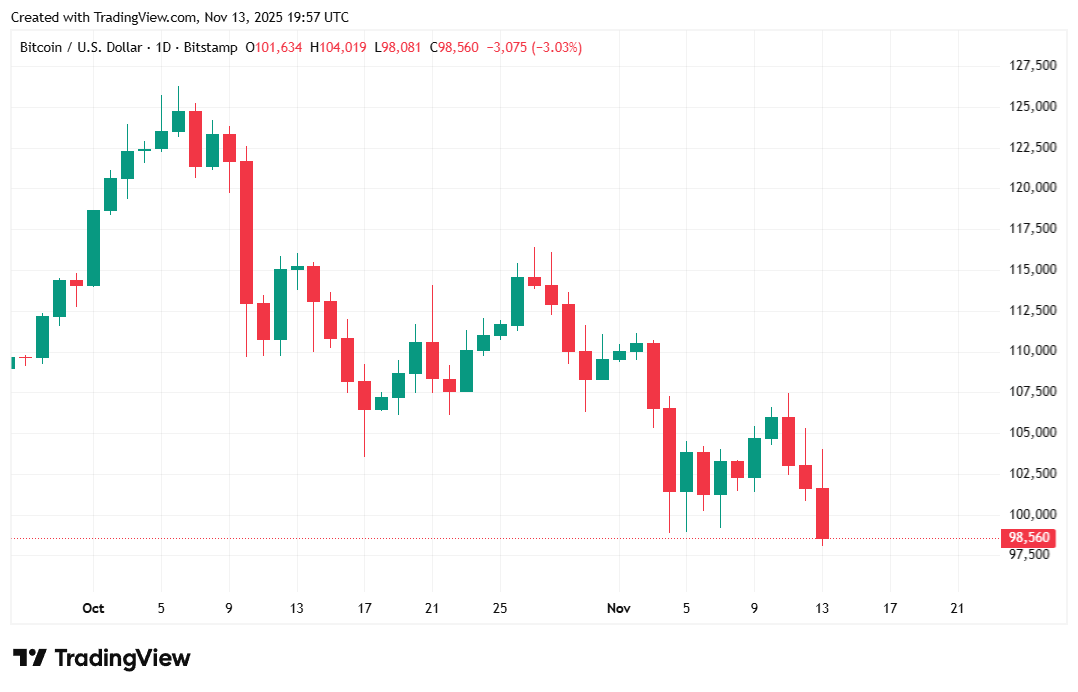
Bitcoin Falls to $98K: A Surprising Link to a New Hemp Ban It sounds too salacious to be true, but a weed ban may have caused bitcoin to drop below $100K. The new restriction was quietly inserted into Wednesday’s landmark funding bill that was widely celebrated for finally ending the longest government shutdown in the U.S. history. But as the government reopens, the hemp industry might just go up in smoke, thanks to the sneaky provision that could shutter a $28 billion sector, putting some 300,000 jobs at risk.
“The government is open, but a hemp industry shutdown has just begun,” said Kentucky Senator Rand Paul. “In true Washington swamp fashion, this hemp ban is not being debated on its own. Once again, Congress created a crisis, then conveniently used the crisis to jam through new laws without debate.” Read more: Bitcoin Stumbles as US Government Shutdown Looms The controversy goes back to 2018, when Paul’s senior colleague Senator Mitch McConnell, also representing Kentucky, championed the 2018 Farm Bill. The legislation greenlighted the use of hemp for industrial purposes. But a loophole that measured hemp concentration by weight instead of quantity spawned a thriving retail industry that sold “hemp” products with enough Tetrahydrocannabinol (THC) to induce a high. Hemp and marijuana are both products of the cannabis plant and both contain THC, but marijuana contains a higher concentration of the active ingredient, typically 0.3% THC or more.
“Unfortunately, companies have exploited a loophole in the 2018 legislation by taking legal amounts of THC from hemp and turning it into intoxicating substances”, McConnell argued on Tuesday. “My efforts to close the loophole and stop this from happening are included in this appropriations package.”
Other catalysts have weighed on bitcoin’s price for the past few weeks, notably the alleged AI bubble, interest rate uncertainty, and even the government shutdown itself. But Thursday’s precipitous drop, may indeed have been triggered by fears of the economic fallout that may ensue if 300,000 jobs are lost and an entire industry is wiped out, all with the stroke of a pen. “This bill contains language that has been airdropped in that will destroy hemp farming in Kentucky and across the United States,” Paul said. “This is the most thoughtless, ignorant proposal to an industry that I’ve seen in a long, long time.” Overview of Market Metrics Bitcoin was priced at $98,655.49 at the time of writing, down 2.63% since Wednesday and also lower by 2.87% for the week, according to Coinmarketcap. The cryptocurrency has been trading between $98,205.58 and $104,005.49 over the past 24 hours.
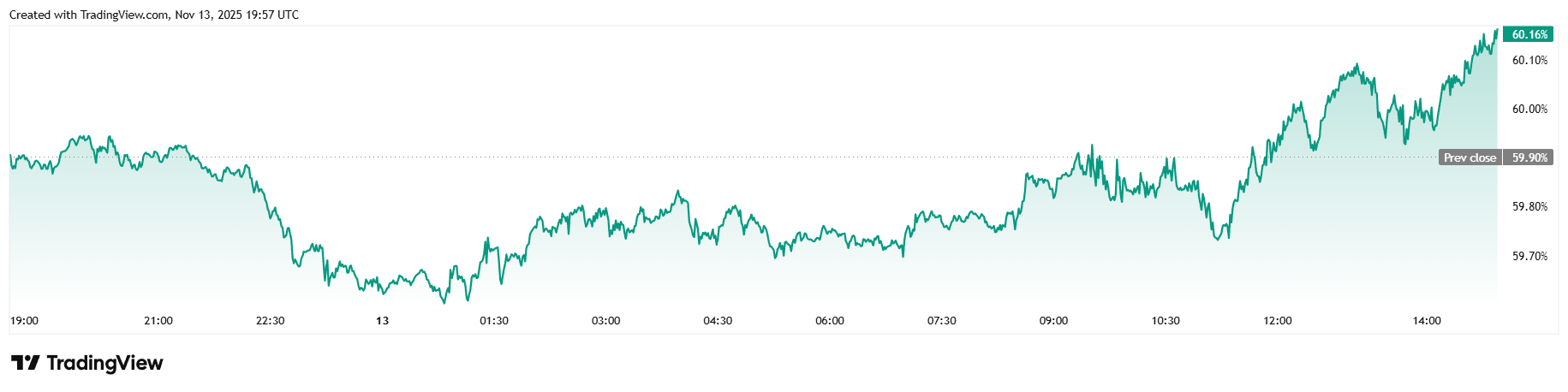
Daily trading volume jumped 45.41% to $92.65 billion as a sell-off broke out, pushing market capitalization below the $2 trillion threshold to $1.96 trillion. But the digital asset still outperformed lesser coins and increased its dominance by 0.39% to 60.15%.
Total value of open bitcoin futures contracts was mostly flat, inching up 0.36% to $66.27 billion over 24 hours, according to Coinglass. But liquidations soared to a total of $235.80 million, and as expected, long investors took the biggest hit, losing $200.47 million in liquidated margin. Short sellers’ losses were largely unchanged from yesterday’s numbers, totaling $35.34 million for the day.